

Measure polyiso insulation with confidence
By The Coffee Shop®.
Learn the proper method for measuring faced rigid cellular polyisocyanurate insulation and checking thickness.
Accurate thickness measurements are essential when verifying faced rigid cellular polyisocyanurate, commonly called polyiso, insulation. According to this article by Hunter Panels, standard specification for faced rigid cellular polyiso allows thickness variation within plus or minus 1/8 inch. However, obtaining a reliable result depends on proper sample preparation and measurement locations.
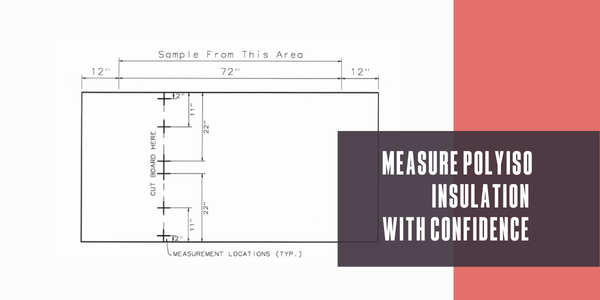
Measuring along the board’s outer edge does not provide an accurate or ASTM-compliant result. Instead, begin by cutting the board through the middle of its 4-foot dimension, creating two sections that each measure 2 feet by 8 feet. Avoid using a razor knife because the measurement cut should be clean and smooth enough to expose a true cross-section of the foam. A caliper is the preferred tool for measuring the sample.
Next, take six thickness measurements to account for natural variations across the board’s surface. Begin each reading at least 1 to 2 inches from the edge and continue taking measurements approximately every 2 feet. One of the six readings should be taken at the center of the board.
Once all six readings have been recorded, add them together and divide the total by six. This calculation provides the board’s average thickness, which can then be compared with the manufacturer’s stated product thickness.
For the insulation to meet ASTM C1289 requirements, the final average must fall within plus or minus 1/8 inch of the labeled thickness. Following a consistent process that includes a clean cut, properly spaced readings and an accurate average help ensure the result represents the board rather than an isolated edge condition.
Hunter Panels recommends following these same measurement principles. Their technical services team is also available to provide additional guidance and support.
Learn more about properly measuring polyiso insulation in accordance with ASTM C1289.
Learn more about Hunter Panels in their Coffee Shop Directory or visit www.hunterpanels.com.
Recommended For You
Unique Features and Benefits of the SSQ II Roof Panel Machine
Read More ...
Putting roofing data to work with AI
Read More ...
An Edge Metal System That Makes A Difference
Read More ...
UP TO THE MINUTE







Comments
Leave a Reply
Have an account? Login to leave a comment!
Sign In