
Avoiding roof damages with leak detection systems
By SMT Research.
Understanding what potential damages there are and having strategies to either prevent or repair those damages on rooftops is critical to roof longevity.
From initial designs on napkins, through to blueprints and shop drawings, it is easy to imagine buildings being constructed as perfectly as they are drawn. While the resulting structures can be magnificent, the construction process is one of complex logistics and timelines subject to external factors such as the weather, the economy and supply chain issues. As the roof system is assembled over the course of months if not years, there are myriad ways in which that roof system can be damaged during construction. Some of these damages are unavoidable, however others might be addressed through education or action.
The modern roof is not just a shelter for the occupants of the structure, but also a platform for amenity spaces such as gardens, basketball courts and even daycare centres. Additionally, the roof is home to essential building mechanisms such as heating, ventilation and air conditioning, as well as a space for water storage, solar power generation and even helipads. All of these assets require the work of multiple trades to install, and while they perform vital functions or add significant value to the building, they also create opportunities for damage to the waterproof membrane meant to keep moisture from getting inside.
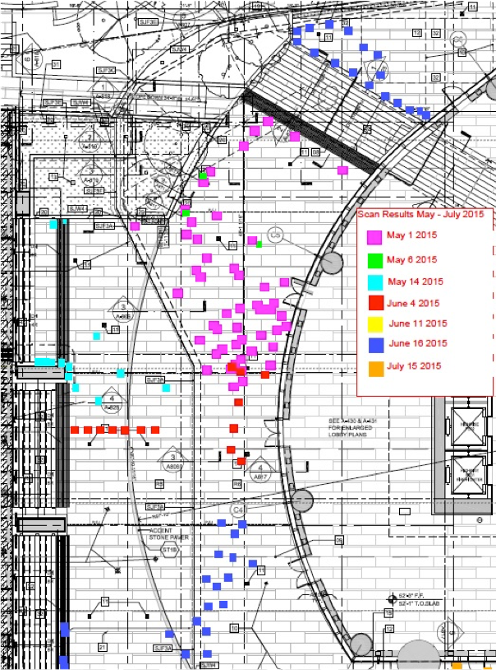
Above: penetrations found in one membrane over multiple leak detection scans
What causes leaks?
Generally speaking, manufacturing quality and installer craftsmanship are not to blame when leaks occur. Membrane manufacturers design their products with great care and rigorously before taking them to market accompanied by clear best practices for installation. Roofing contractors know their trade well and take great pride in their workmanship, doing their best to complete roofing systems with defect-free membranes.
The main culprits for leaks and water damage on newly constructed roof systems are construction sequencing, and damage done by other tradespeople. These two factors combined make up the majority of damages found on large commercial flat roofing systems, the following table summarizes our findings when scanning roofs - with an average of 5.1 penetrations of the waterproof membrane per thousand square feet scanned.
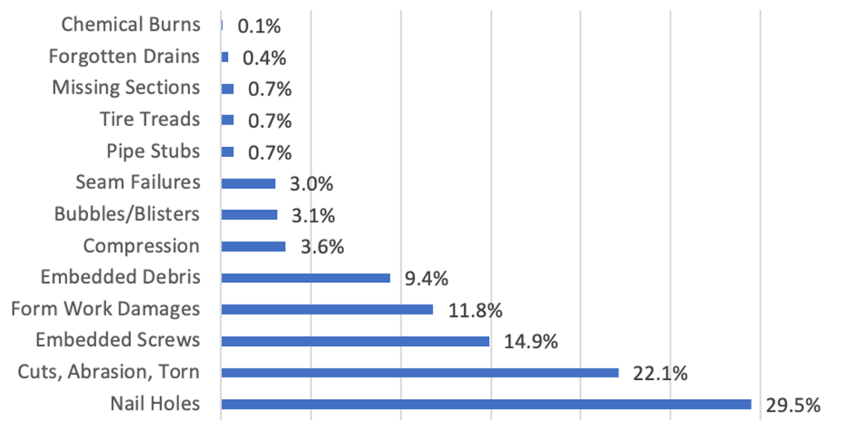
Above: chart reflecting the source of damages to waterproof membranes found during leak detection scans
Types of roof assembly
Large flat low-slope roof assemblies usually fall into two categories; conventional or inverted. The simplest way to understand the difference is to observe where the waterproof membrane sits within the layers of the roofing system. On a conventional roof assembly, the waterproof membrane is the top-most layer, capping the assembly and in theory sealing the roof from the elements. On an inverted (sometimes called protected) roof system, the waterproof membrane is far lower in the assembly - either installed directly onto the wood/concrete/steel structural element of the roof or else on top of a levelling layer. On both conventional and inverted roof assemblies the membrane is intended to be a monolithic layer without breaches (except for drainage or conduits), however in both cases there are many ways in which the exposed membrane might be damaged during construction - all of the risks mentioned in this article are applicable to both types.
Unavoidable damages
Walk through any city and you are bound to see tens of cranes lifting heavy equipment and materials onto under-construction buildings. The rooftop is a busy hive of construction activity, and must be made safe for the people at work. Safety fences must be secured to the low-slope roofing, and are generally ‘mechanically fastened’ using screws or nails which penetrate the membrane on the parapet or in the field of the roof. These penetrations can be found afterwards using a leak detection scan, and must be patched before the roof system can be considered complete.
Also unavoidable is the payload of all those cranes; everything from bricks and mortar to AC units and glazing units must be lifted onto the roof before they are installed in the upper floors and rooftop. By necessity, as inner-city projects often don’t have off-site storage, the rooftop becomes a construction ‘staging area’ where materials are kept. These materials can cause compression or else penetrations into the membrane if stored incorrectly, with the weight of the materials not dispersed over a wide enough area. A dolly might be useful for transporting equipment across the site, however if left for a prolonged period the weight of the material can press the wheels of the dolly into the membrane - causing damage that may go undetected.
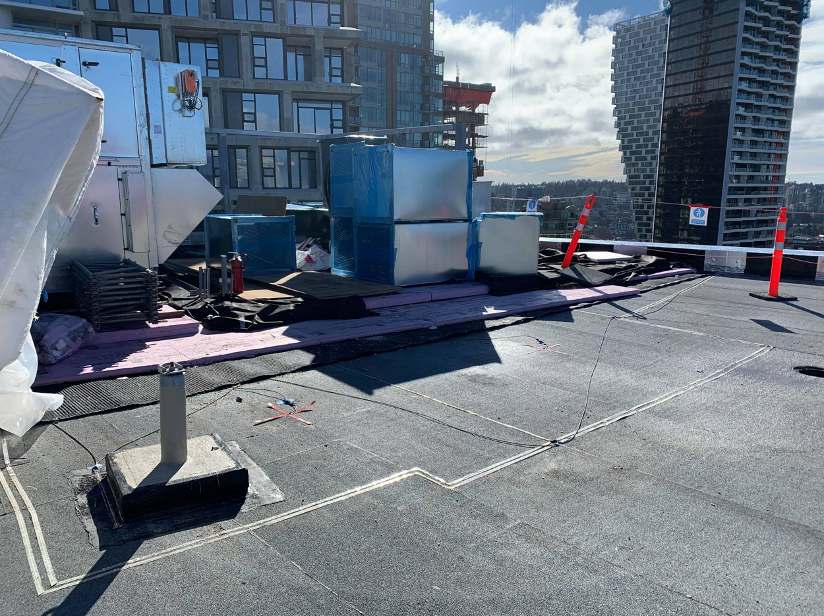
Above: inverted rooftop assembly used as a staging area while the membrane is still exposed
While it is not a factor during construction, it should be noted that all building products naturally deteriorate with time - an unavoidable fact. Furthermore, the roof is perhaps the most exposed structural element of a building, taking damage from the extreme temperatures and weather events as well as human activity over the course of its lifespan. This makes it all the more important that risks to the membrane are properly accounted for so as to get the maximum value out of the roof system.
Avoidable damages
Having performed leak detection scans on thousands of large low-slope roofs we have seen a multitude of ways in which the membrane has become damaged. Many of these are avoidable through training or else risk mitigation strategies.
A rule of thumb that can be applied across any site is treating the waterproof membrane as a finished product that ought to be protected - just as windows and stainless steel elements being covered by protective layers until construction is complete. For membranes, using a night seal to protect the roof assembly prior to completion is a basic and effective method. The use of the membrane as a staging area is often unavoidable, however using designated walkways over coverboard as well as storing equipment on pallets that distribute the weight are good ways to protect the membrane.
On conventional roofs in particular we see issues of construction moisture being sealed within the membrane - often from work not being complete within a day and then the night-seal failing (generally due to improper installation) allowing water from rainfall to seep under the incomplete membrane. The most common way that moisture can get into the roofing system is parapet walls being left open - with the work performed by other trades whose timeline may not align with the roofing contractors. The best solution here is education; the roof should be looked at holistically as a single system that is not complete until sealed both on top and from the sides.
One project that was under construction during the winter months saw a membrane exposed to an overnight deluge of rainwater which then froze - coating the membrane in several centimeters of ice. We returned to site to see several contractors working with jackhammers to break the ice and access the membrane in order to place down insulation. This was a simple matter of the contractors not understanding the damage this could cause to the membrane, damage which was confirmed when a leak detection scan was performed. Education from the manufacturer or a site supervisor would eliminate this unnecessary damage.
Damage or risk to the membrane is often detected during construction, leading to re-work as trades remediate the issue. This was the case when a roof component had been installed incorrectly and needed to be replaced. During this re-work, the membrane is used as a staging area during efforts that were not part of the original construction schedule and therefore may be under significant time pressure - causing defects through rushed work. This can be resolved through greater care and attention being given to the storing of materials during work on an exposed membrane, and ideally requiring a leak detection scan prior to the re-covering of the membrane.
A memorable project caused some head-scratching as leak detection scans found multiple holes around the windows and doors across the site. Eventually it was understood that the primer used to apply protective blueskin onto vertical surfaces had dripped down onto the roof; primer is a solvent which burns through the membrane. On another site we saw chemical damage from 10 litres of gasoline spilled by landscapers as they were putting finishing touches to a green roof. The gasoline pooled in an area with no drainage, and ate through the membrane. While a relatively rare occurrence, these chemical damages to the membrane are avoidable by simply putting down drip cloth before using primer, as well as clearing up any spill that happens on site.
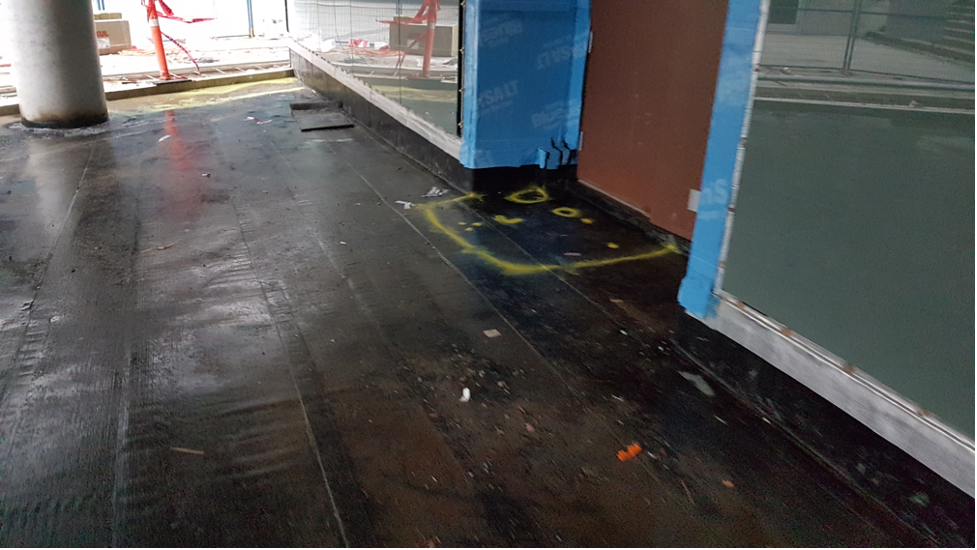
Above: Chemical burns on the waterproof membrane from primer
On green roofs, we have seen issues on multiple sites where landscaping elements have been inadvertently pushed under protective layers - this was especially prevalent where new details had been added or rework performed after the overburden had been applied. Small stones and other landscaping elements that end up under insulation or drainage matts are compressed by the weight of overburden into the membrane - creating deficiencies or penetrations that lead to leaks. This is avoidable by taking care to ensure any area excavated for additional construction be made clear and tidy prior to work being carried out, with a verification scan as well as a visual inspection prior to recovering.
Intentional penetrations
Not all penetrations of the membrane are accidental. HVAC units, vents, piping, roof lights, gas lines, drains; all of these puncture the membrane of the roofing system. It is very common for the membrane to be penetrated by forming nails used for creating concrete elements such as planter walls, curb separations etc - generally these are repaired once the work is finished (many are missed, only to be found by an electronic leak detection scan as part of quality assurance). These are of course common and essential elements of the structure and are designed to be watertight to prevent moisture entering the roof system - however in a practical sense they are the most obvious vulnerabilities to the membrane. Due to construction sequencing, these elements are often installed after the roofing contractor has completed work, meaning there is no “advocate” for the health of the membrane present. The best protection for the membrane is to install a leak detection system, which can be used to verify the health of the membrane from the moment it is installed. Furthermore, during installation and subsequent scans, the leak detection install team will document the condition of the roof, with particular attention paid to these potential problem points - generating photos, videos, and reports that can be invaluable in future leak investigations.
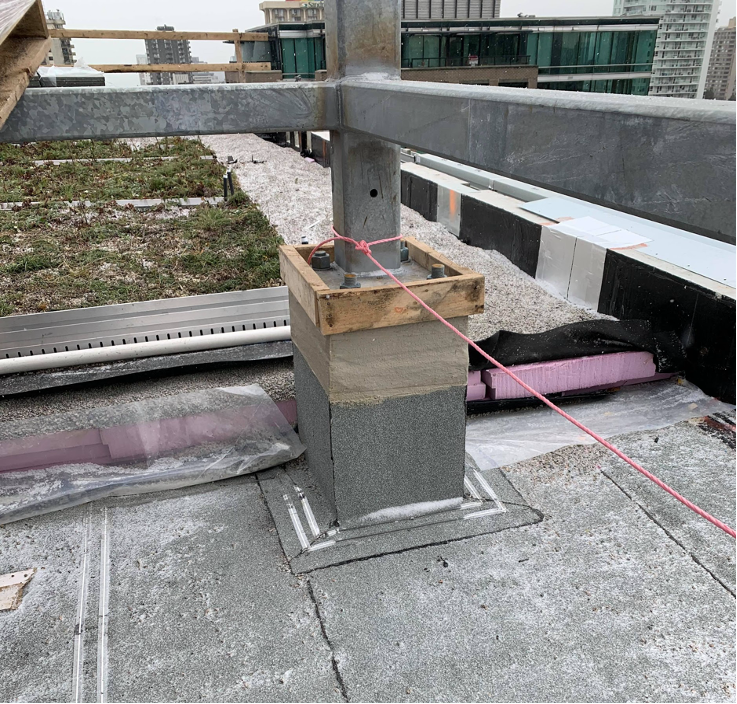
Above: the tape lines around the base of this support column are sensors that isolate this vulnerable area where the membrane has been deliberately punctured, for future monitoring
Conclusions
The roof is a critical building system that requires skill and attention to install. Throughout construction, the waterproof membrane is vulnerable to damages in many ways - some of which are either intentional or unavoidable. There are other damages which we find on almost every roof we scan, and these are absolutely avoidable. The risk of all damage types to the membrane can be mitigated through proper education and planning - understanding what potential damages there are and having strategies to either prevent or repair those damages. The absolute best protection for the roof membrane is to have a leak detection system installed, which can scan the membrane throughout construction and the operational life of the structure. In addition, a leak detection system install team will create a historical report of the roof condition during construction, that can be invaluable to building owners at a later date as eventually all roofs will require attention.
Learn more about SMT Research in their Coffee Shop Directory or visit www.smtresearch.ca.
Recommended For You

Inside the 2026 Texas Roofing Conference
Read More ...
The Equip experience: Churchill Downs, puppies and bourbon
Read More ...
Check Out MRCA’s New Training Program!
Read More ...
UP TO THE MINUTE





Comments
Leave a Reply
Have an account? Login to leave a comment!
Sign In